Have a German name and want to find out what it is? Having trouble, tracing your family tree? You are not alone. German surnames tell of occupations, residences, dads and even nicknames. They’re all miniature history books. Many were selected hundreds of years ago when towns became populated and individuals became known by more than their first name.
Nowadays millions of people bear these names all over the world. In this guide, you will find out the origins of German last names and their construction. The primary types, regional styles and spelling tips will also be introduced. Several are short and simple.
Others are lengthens and majestic. And, as a bonus, you’ll receive some easy tips for doing your own genealogical research. This guide is for anyone who wants to learn more, is writing a story or is searching for their family history. Let’s go to the first page.
How German Last Names Began
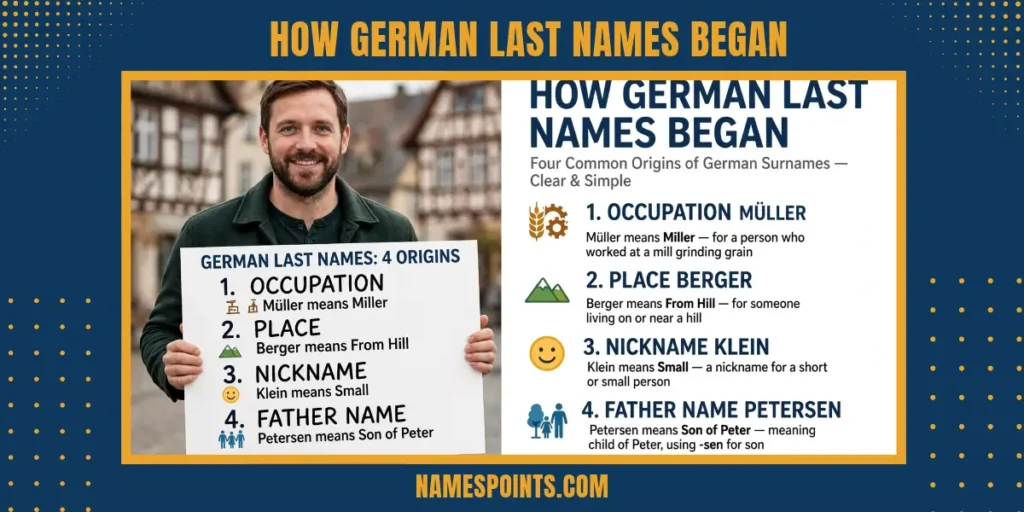
In the early Middle Ages, one first name was enough in a small village. As towns and trade grew, people needed a second name to avoid confusion.
Surnames began to appear in German-speaking lands around the 12th century, first among city dwellers and nobles. Over the next few hundred years, they spread to farmers and villagers. By the 1500s, most families used a name that passed from parent to child.
- Cities adopted surnames earlier than the countryside.
- Southern and western regions generally started before the north and east.
- Early surnames often changed from one generation to the next.
- Church records helped fix spellings over time.
- Laws in later centuries made surnames official and permanent.
How To Research German Last Names And Your Family
Tracing a German surname takes patience, but the steps are clear.
- Start at home. Gather names, dates, and places from relatives.
- Find the town of origin. Immigration, naturalization, and passenger records often list it.
- Use church books. Parish registers record births, marriages, and deaths and often go back several centuries.
- Check civil records. Germany began nationwide civil registration in 1876, and some regions started earlier.
- Try trusted databases. Large genealogy sites and regional archives hold many German records.
- Watch for spelling variants. One family may appear under several spellings.
Suit your feline friend’s curious and independent spirit by browsing these charming German cat names brimming with personality.
Funny German Last Names
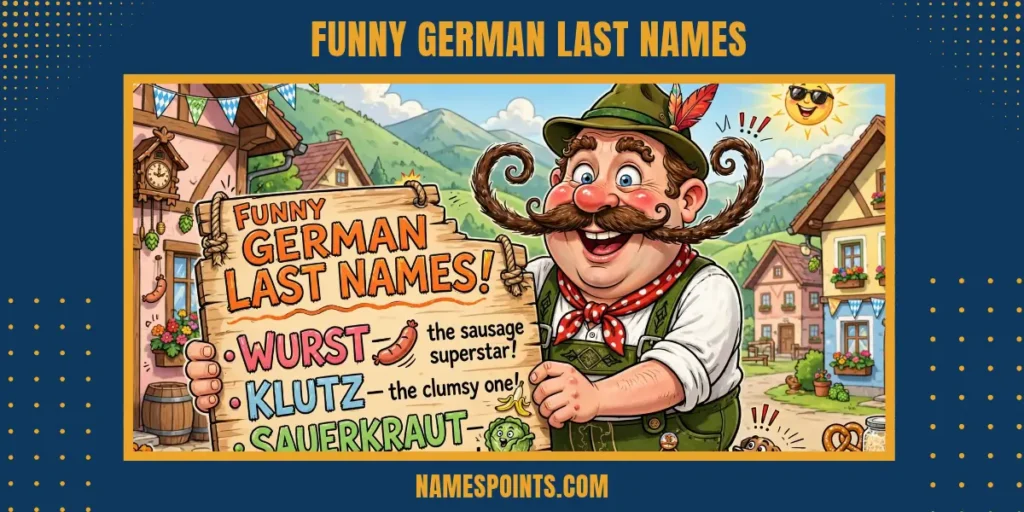
Some German last names get a laugh because of what the words mean in everyday German or how they sound to English speakers.
Many started as nicknames for a person’s looks, habits, or job, so odd meanings are common. A name that sounds silly today often had a very practical reason behind it centuries ago. Funny surnames work well for fictional characters, comedy writing, and trivia. If you use one for a real person, keep the joke kind, since the family has lived with that name for generations.
| Funny German Last Names | Origin | Meaning |
| Faulhaber | Nickname | Lazy oats, someone slow to harvest |
| Habenicht | Nickname | Have-not, a poor person |
| Nimmersatt | Nickname | Never full, a big eater |
| Süßmilch | Nickname | Sweet milk, a dairy seller |
| Nacktgeboren | Nickname | Born naked |
| Siebenhaar | Nickname | Seven hairs, a balding man |
| Hasenfuß | Nickname | Hare’s foot, a coward |
| Pfefferkorn | Trade | Peppercorn, a spice dealer |
| Gänswein | Nickname | Goose wine, a goose farmer who also sold drink |
| Dickmann | Nickname | Thick man, a stout fellow |
| Kuckuck | Nickname | Cuckoo, a quirky person |
| Zwiebel | Nickname | Onion, an onion grower or seller |
| Schmalz | Trade | Lard, a fat seller |
| Löffelholz | Trade | Spoon wood, a spoon carver |
| Krummbein | Nickname | Crooked leg |
| Langbein | Nickname | Long leg |
| Krauskopf | Nickname | Curly head |
| Biersack | Nickname | Beer sack, a heavy drinker |
| Trinkaus | Nickname | Drink up, a cheerful drinker |
| Knoblauch | Nickname | Garlic, a garlic grower |
| Kalbfleisch | Trade | Veal, a butcher |
| Hundertmark | Nickname | Hundred marks, a person of means |
| Süßkind | Nickname | Sweet child |
| Lachmann | Nickname | Laughing man |
| Nachtigall | Nickname | Nightingale, a singer |
| Gutjahr | Nickname | Good year, born in a fine harvest |
| Fröhlich | Nickname | Cheerful |
| Wunderlich | Nickname | Odd or whimsical |
| Butterweck | Trade | Butter roll, a baker |
| Rotbart | Nickname | Red beard |
Find a flexible option that suits any child gracefully by browsing these adaptable German unisex names rich in timeless appeal.
Wealthy German Last Names
A last name can’t tell you whether a family is rich, but certain names became linked with well-known merchant, banking, and industrial families over time.
The word “von” also points to noble ancestry in many cases, though it isn’t proof of wealth today. Many families with famous business names started out as farmers, craftspeople, or traders.
For fiction, names with a formal, polished sound often suit a rich or powerful character. For real-world research, check family history records instead of guessing from the name alone.
| Wealthy German Last Names | Origin | Meaning |
| Reich | Nickname | Rich |
| Reichmann | Nickname | Rich man |
| Reichert | Nickname | Rich ruler, from an old given name |
| Goldmann | Nickname | Gold man, a wealthy person or gold dealer |
| Fugger | Augsburg merchant dynasty | Banking family of the Renaissance |
| Welser | Augsburg merchant dynasty | Trading house that rivaled the Fuggers |
| Krupp | Essen industrial dynasty | Steel and arms makers |
| Thyssen | Ruhr industrial dynasty | Steel and heavy industry |
| Siemens | Industrial dynasty | Electrical engineering empire |
| Bosch | Industrial dynasty | Auto parts and engineering |
| Quandt | Industrial dynasty | Family behind a car and battery fortune |
| Oetker | Bielefeld business family | Baking goods and food empire |
| Haniel | Ruhr business family | Trading and mining fortune |
| Metzler | Frankfurt banking family | Private bank, old money |
| Rothschild | Frankfurt banking family | Red shield, a famed banking house |
| Warburg | Hamburg banking family | Merchant bankers |
| Henkel | Düsseldorf business family | Household products fortune |
| Merck | Darmstadt business family | Pharmaceutical dynasty |
| Reemtsma | Hamburg business family | Tobacco and philanthropy fortune |
| Albrecht | Retail dynasty | Discount supermarket fortune |
| Burda | Offenburg media family | Publishing empire |
| Boehringer | Pharmaceutical family | Medicine and chemicals |
| Freudenberg | Weinheim business family | Industrial materials, family-owned |
| Bertelsmann | Gütersloh media family | Publishing and media group |
| Piëch | Austrian-German family | Car industry heirs |
| Porsche | Car-making family | Sports car dynasty |
| Benz | Car-making family | Pioneer of the automobile |
| Schaeffler | Herzogenaurach family | Bearings and auto parts |
| Würth | Künzelsau family | Fasteners and tools empire |
| Springer | Publishing family | Newspaper and media fortune |
Capture the elegance of bygone eras for your newborn by reviewing these classic old fashioned German names steeped in timeless warmth.
Uncommon German Last Names
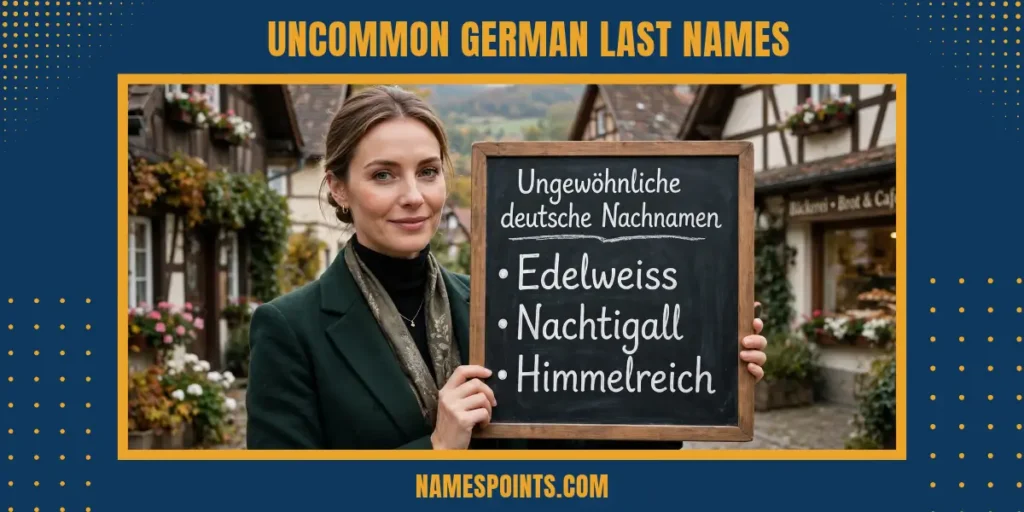
Uncommon German last names often come from small villages, old dialects, or occupations that no longer exist. Some have only a few hundred bearers, which makes them stand out.
They give characters, brands, and family trees a distinct feel. Regional spelling differences can make a name even rarer. If you’re researching one, look at local church records and archives, since small-town names often show up there first.
| Uncommon German Last Names | Origin | Meaning |
| Abendroth | Nickname | Evening red, sunset |
| Bärwolf | Nickname | Bear wolf, fierce person |
| Dörrie | Regional | Variant tied to a Saxon family |
| Eisenhardt | Given-name based | Iron hard |
| Giesebrecht | Given-name based | Pledge bright |
| Hollenbach | Place-based | Brook in the hollow |
| Ihlenfeld | Place-based | Field of the owls |
| Kaltenbrunner | Place-based | Cold spring |
| Lilienthal | Place-based | Lily valley |
| Mittelstaedt | Place-based | Middle place |
| Nachtsheim | Place-based | Home of the night |
| Oelschlägel | Occupational | Oil beater, an oil presser |
| Pechstein | Nickname | Pitch stone, a dark rock |
| Quackenbusch | Place-based | Swamp bush |
| Rosenkranz | Nickname | Rose wreath or rosary |
| Sonnenschein | Nickname | Sunshine |
| Unruh | Nickname | Unrest, a restless person |
| Wolkenhauer | Occupational | Cloud hewer, from a mason’s nickname |
| Zuckmayer | Occupational | Sugar steward |
| Ziegenbalg | Occupational | Goat skin, a leather worker |
| Bärenfänger | Occupational | Bear catcher |
| Eulenspiegel | Nickname | Owl mirror, from a folk trickster |
| Edelmann | Nickname | Nobleman |
| Feuerstein | Nickname | Flint |
| Grünewald | Place-based | Green forest |
| Himmelreich | Place-based | Kingdom of heaven |
| Immergrün | Nickname | Evergreen |
| Jungbluth | Nickname | Young blood |
| Kirschbaum | Place-based | Cherry tree |
| Tiefenbacher | Place-based | From the deep brook |
Reflect grace and inner radiance in your baby’s identity by exploring these lovely German names meaning beautiful full of poetic elegance.
German Last Names Male
Most German surnames were passed down through the male line, so the traditional forms you see in records are usually the male versions. They often come from a father’s name, a trade, a place, or a nickname.
These names tend to have a short, solid sound with clear roots in old German words. Many are still the family name for both men and women in a household today. When tracing a name, start with the male line, since older records follow it most closely.
| German Last Names Male | Origin | Meaning |
| Hartmann | Given-name based | Hardy man |
| Baumann | Occupational | Farmer, builder |
| Neumann | Nickname | New man, a newcomer |
| Lehmann | Occupational | Feudal tenant |
| Hoffmann | Occupational | Man of the farmstead |
| Bergmann | Place-based | Mountain man, a miner |
| Steinmann | Place-based | Stone man |
| Kellermann | Occupational | Cellar man, a wine steward |
| Hausmann | Place-based | House man, a caretaker |
| Holzmann | Occupational | Wood man, a woodcutter |
| Altmann | Nickname | Old man |
| Jungmann | Nickname | Young man |
| Friedmann | Given-name based | Man of peace |
| Herrmann | Given-name based | Army man |
| Ostermann | Place-based | Man from the east |
| Westermann | Place-based | Man from the west |
| Rothmann | Nickname | Red man, red-haired |
| Kleinmann | Nickname | Small man |
| Großmann | Nickname | Big man |
| Weißmann | Nickname | White man, fair-haired |
| Brinkmann | Place-based | Man from the village green |
| Lindemann | Place-based | Man by the linden tree |
| Tiedemann | Given-name based | People’s man |
| Engelmann | Given-name based | Angel man |
| Heinemann | Given-name based | Home ruler’s man |
| Kuhlmann | Place-based | Man from the hollow |
| Niemann | Nickname | New man |
| Sandmann | Place-based | Man of the sandy land |
| Husmann | Place-based | House man, Low German form |
| Wiegmann | Given-name based | Fighter’s man |
Fill your child’s life with warmth and deep affection by choosing from these heartfelt German names meaning love rich in tender sentiment.
German Last Names Female
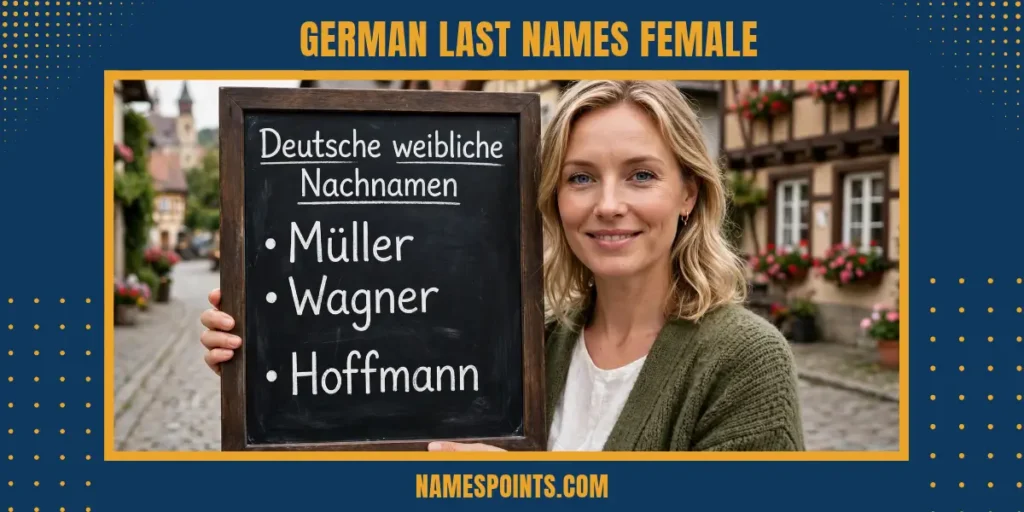
Today, women in Germany usually carry the same surname form as the men in their family. In earlier centuries, though, some regions added an “-in” ending to a woman’s surname, so a baker’s wife or daughter might appear in records with a slightly different spelling.
That older habit can confuse people who research family history. Marriage records also matter, since a woman’s name may change after she marries. Knowing both patterns helps you read old documents correctly.
| German Last Names Female | Origin | Meaning |
| Müllerin | Historic feminine form | Female miller |
| Schmidtin | Historic feminine form | Female smith |
| Meierin | Historic feminine form | Steward’s wife or daughter |
| Fischerin | Historic feminine form | Female fisher |
| Weberin | Historic feminine form | Female weaver |
| Schneiderin | Historic feminine form | Female tailor |
| Wagnerin | Historic feminine form | Wagon maker’s wife |
| Beckerin | Historic feminine form | Female baker |
| Schulzin | Historic feminine form | Village head’s wife |
| Bauerin | Historic feminine form | Farmer’s wife |
| Kochin | Historic feminine form | Female cook |
| Richterin | Historic feminine form | Judge’s wife |
| Wolfin | Historic feminine form | She-wolf, wolf’s wife |
| Fuchsin | Historic feminine form | Vixen, fox’s wife |
| Schäferin | Historic feminine form | Female shepherd |
| Krügerin | Historic feminine form | Innkeeper’s wife |
| Zimmerin | Historic feminine form | Carpenter’s wife |
| Försterin | Historic feminine form | Forester’s wife |
| Jägerin | Historic feminine form | Female hunter |
| Gärtnerin | Historic feminine form | Female gardener |
| Braunin | Historic feminine form | Brown-haired woman |
| Königin | Historic feminine form | Queen, king’s wife |
| Müllersche | Wife-of form | The miller’s wife |
| Schmidtsche | Wife-of form | The smith’s wife |
| Meiersche | Wife-of form | The steward’s wife |
| Beckersche | Wife-of form | The baker’s wife |
| Webersche | Wife-of form | The weaver’s wife |
| Fischersche | Wife-of form | The fisher’s wife |
| Wagnersche | Wife-of form | The wagon maker’s wife |
| Schulzesche | Wife-of form | The village head’s wife |
Inspire a fearless spirit and bold heart in your little one with these courageous German names meaning brave rooted in heroic tradition.
Occupational German Last Names
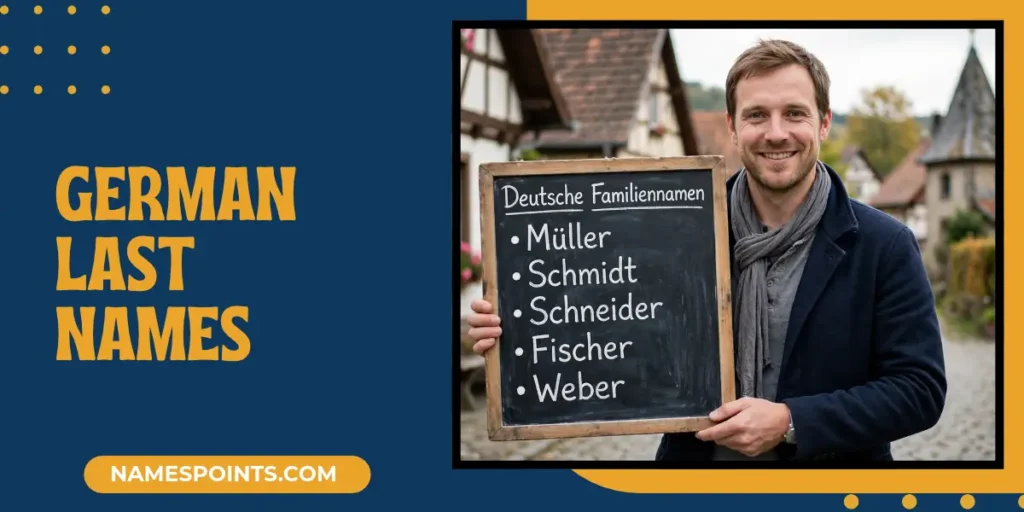
Occupational surnames are among the most common in Germany. They began as descriptions of a person’s job, such as farming, baking, blacksmithing, weaving, or milling.
Many sound plain today, but each tells a small story about daily life in a medieval town. Spelling often changed by region, which created several versions of the same trade name. These surnames are a great way to learn what work shaped a family’s past.
| Occupational German Last Names | Origin | Meaning |
| Müller | Occupational | Miller |
| Schmidt | Occupational | Smith |
| Schneider | Occupational | Tailor |
| Fischer | Occupational | Fisherman |
| Weber | Occupational | Weaver |
| Meyer | Occupational | Steward or tenant farmer |
| Wagner | Occupational | Wagon maker |
| Becker | Occupational | Baker |
| Schäfer | Occupational | Shepherd |
| Bauer | Occupational | Farmer |
| Koch | Occupational | Cook |
| Richter | Occupational | Judge |
| Zimmermann | Occupational | Carpenter |
| Schröder | Occupational | Tailor, Low German form |
| Schumacher | Occupational | Shoemaker |
| Krüger | Occupational | Innkeeper |
| Böttcher | Occupational | Barrel maker |
| Kaufmann | Occupational | Merchant |
| Jäger | Occupational | Hunter |
| Förster | Occupational | Forester |
| Metzger | Occupational | Butcher |
| Gärtner | Occupational | Gardener |
| Maurer | Occupational | Bricklayer |
| Decker | Occupational | Roofer |
| Sattler | Occupational | Saddle maker |
| Küster | Occupational | Church sexton |
| Kramer | Occupational | Small shopkeeper |
| Glaser | Occupational | Glazier |
| Schreiner | Occupational | Joiner or cabinet maker |
| Wirth | Occupational | Host or innkeeper |
Patronymic German Last Names
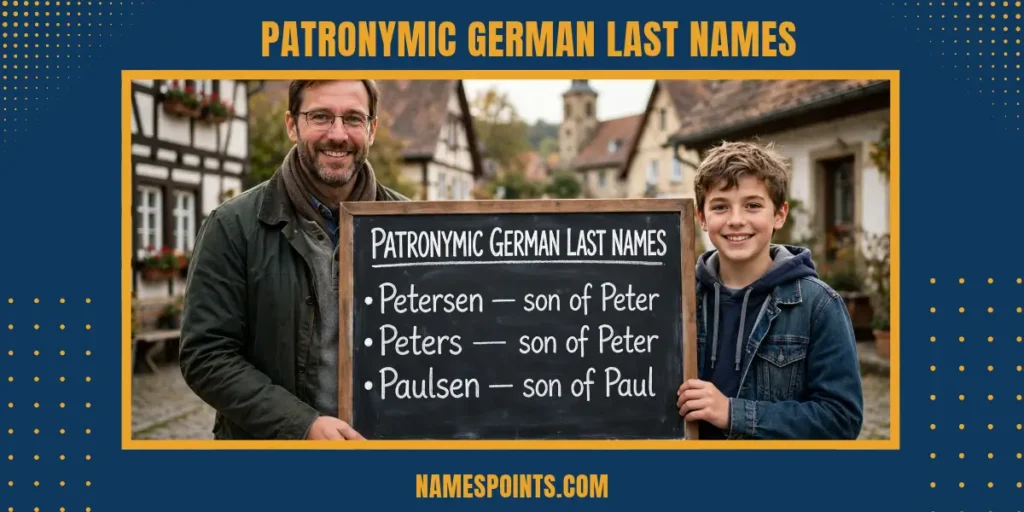
Patronymic surnames come from a father’s first name, usually with an ending that means “son of.” Northern regions and areas near the coast used this pattern more often. Over time, many families kept one fixed surname instead of changing it each generation.
You can often spot these names by their endings, which vary by region and dialect. They’re useful clues when you trace a family tree back through old church books.
| Patronymic German Last Names | Origin | Meaning |
| Peters | Patronymic | Son of Peter |
| Petersen | Patronymic, North German | Son of Peter |
| Jansen | Patronymic, North German | Son of Jan |
| Janssen | Patronymic, Low German | Son of Jan |
| Hansen | Patronymic, North German | Son of Hans |
| Heinrichs | Patronymic | Son of Heinrich |
| Heinze | Patronymic | Short form of Heinrich, his son |
| Hinz | Patronymic | Short form of Heinrich |
| Kunz | Patronymic | Short form of Konrad |
| Claasen | Patronymic, Low German | Son of Claas, short for Nikolaus |
| Thomsen | Patronymic, North German | Son of Thomas |
| Carstens | Patronymic, Frisian | Son of Carsten |
| Detlefsen | Patronymic, North German | Son of Detlef |
| Andresen | Patronymic, North German | Son of Andreas |
| Matthiesen | Patronymic, North German | Son of Matthias |
| Martens | Patronymic, Low German | Son of Martin |
| Meinecke | Patronymic | Little Meino, descendant of a strong man |
| Jacobs | Patronymic | Son of Jacob |
| Jacobsen | Patronymic, North German | Son of Jacob |
| Lorenzen | Patronymic, North German | Son of Lorenz |
| Michels | Patronymic | Son of Michael |
| Wilms | Patronymic, Rhineland | Son of Wilhelm |
| Willems | Patronymic, Lower Rhine | Son of Wilhelm |
| Jürgens | Patronymic, Low German | Son of Jürgen |
| Johannsen | Patronymic, North German | Son of Johann |
| Paulsen | Patronymic, North German | Son of Paul |
| Nissen | Patronymic, North German | Son of Nis, short for Nikolaus |
| Ohlsen | Patronymic, North German | Son of Ole |
| Ottens | Patronymic | Son of Otto |
| Rolfes | Patronymic | Son of Rolf |
Place-Based German Last Names
Place-based surnames describe where a family lived, such as near a hill, a river, a forest, or a specific village. Others point to a town the family moved from.
These names can help you narrow down where an ancestor came from. Because villages merged or changed their names over time, you may need a historical map to match a surname to a location. They’re a rewarding starting point for anyone researching their roots.
| Place-Based German Last Names | Origin | Meaning |
| Schwabe | Regional | Person from Swabia |
| Franke | Regional | Person from Franconia |
| Sachse | Regional | Person from Saxony |
| Bayer | Regional | Person from Bavaria |
| Thüringer | Regional | Person from Thuringia |
| Preuß | Regional | Person from Prussia |
| Pommer | Regional | Person from Pomerania |
| Friese | Regional | Person from Frisia |
| Hesse | Regional | Person from Hesse |
| Böhme | Regional | Person from Bohemia |
| Pohl | Regional | Person from Poland |
| Wendt | Regional | Person of the Wendish, Slavic people |
| Schlesinger | Regional | Person from Silesia |
| Rheinländer | Regional | Person from the Rhineland |
| Holsteiner | Regional | Person from Holstein |
| Westfal | Regional | Person from Westphalia |
| Bremer | City-based | Person from Bremen |
| Dresdner | City-based | Person from Dresden |
| Lüneburg | City-based | From Lüneburg |
| Marburg | City-based | From Marburg |
| Wittenberg | City-based | From Wittenberg |
| Mansfeld | Place-based | From Mansfeld |
| Frankenberg | Place-based | Franks’ hill |
| Lindenau | Place-based | Linden meadow |
| Hohenstein | Place-based | High stone |
| Altenburg | Place-based | Old castle |
| Bernburg | Place-based | From Bernburg |
| Reichenbach | Place-based | Rich brook |
| Steinbach | Place-based | Stone brook |
| Lübke | City-based | Little man from Lübeck |
Regional Patterns In German Last Names
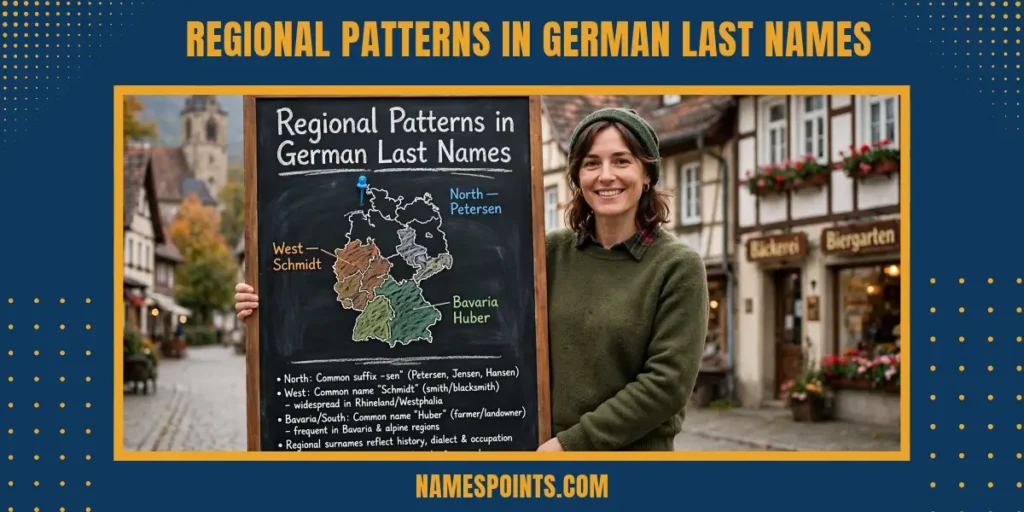
German surnames vary a lot by region. The north often has patronymic and coastal names, while the south tends to have different endings and dialect spellings.
Border areas show influence from nearby languages, such as Slavic, Dutch, or French. Knowing the typical patterns of a region can help you guess where a family might have come from. Treat that as a clue and not a proof, since people moved often.
| NaRegional Patterns In German Last Namesme | Origin | Meaning |
| Niemeyer | Westphalia, “-meyer” farm names | New steward |
| Westerkamp | Westphalia, “-kamp” field names | Western field |
| Brockhaus | Westphalia, “-haus” house names | House by the marsh |
| Strothmann | Westphalia, “-mann” place names | Man from the thicket |
| Huber | Bavaria and Austria, “-huber” | Farmer who holds a full farm |
| Gruber | Bavaria and Austria | Dweller by the pit or hollow |
| Mayrhofer | Bavaria and Austria, “-hofer” | Steward’s farmstead |
| Leitner | Bavaria and Austria | Dweller on the slope |
| Haslinger | Bavaria and Austria, “-inger” | From the hazel grove |
| Obermaier | Bavaria and Austria | Upper steward |
| Häberle | Swabia, “-le” diminutive | Little oat grower |
| Hägele | Swabia, “-le” diminutive | Little hedge |
| Schäuble | Swabia, “-le” diminutive | Little sheaf |
| Kuhnle | Swabia, “-le” diminutive | Little Konrad |
| Brändle | Swabia, “-le” diminutive | Little burned clearing |
| Schmitz | Rhineland | Smith, Rhenish form |
| Hilgers | Rhineland, “-s” genitive | Hilger’s son |
| Küppers | Rhineland | Cooper, barrel maker |
| Lenzen | Rhineland, “-en” genitive | Son of Lenz |
| Ahrens | North coast, “-s” genitive | Son of the eagle |
| Harms | North coast, “-s” genitive | Son of Harm, from Hermann |
| Boysen | North coast, “-sen” | Son of Boy |
| Tiedje | North coast, “-je” diminutive | Little Dietrich |
| Nowak | Eastern, Slavic “-ak” | New man |
| Kowalski | Eastern, Slavic “-ski” | Of the smith |
| Bartsch | Eastern, Slavic influence | From Bartholomäus |
| Kretschmer | Eastern, Slavic influence | Innkeeper |
| Mielke | Eastern, Slavic “-ke” | Dear one |
| Hennig | Saxony | Little Hans |
| Lommatzsch | Saxony, Sorbian place name | From the Saxon town of Lommatzsch |
Jewish German Last Names
Many Jewish families in German-speaking lands took fixed surnames during the late 1700s and early 1800s, when authorities required them. Some chose names linked to places, trades, family traditions, or biblical figures, while others were assigned names by officials.
Because of this history, a surname alone can’t confirm a person’s background, so avoid assumptions. Jewish genealogy archives and community records are the most reliable places to research. Approach the topic with care, since many families’ names and records were affected by persecution in the twentieth century.
| Jewish German Last Names | Origin | Meaning |
| Levi | Hebrew | Tribe of Levi, temple helpers |
| Kohn | Hebrew via German | Priest, from the Kohanim line |
| Katz | Acronym | Priest of righteousness |
| Kaplan | Latin via German | Chaplain, also used for priestly descent |
| Rosenthal | German ornamental | Rose valley |
| Rosenberg | German ornamental | Rose mountain |
| Goldstein | German ornamental | Gold stone |
| Goldberg | German ornamental | Gold mountain |
| Silberstein | German ornamental | Silver stone |
| Blumenthal | German ornamental | Flower valley |
| Bernstein | German ornamental | Amber |
| Mendelssohn | Patronymic | Son of Mendel |
| Oppenheimer | Place-based | From Oppenheim |
| Landau | Place-based | From Landau |
| Friedländer | Place-based | From Friedland |
| Horwitz | Place-based | From Hořovice in Bohemia |
| Adler | German symbolic | Eagle |
| Löwenthal | German ornamental | Lion valley |
| Hirsch | German symbolic | Deer, linked to Naphtali |
| Wertheimer | Place-based | From Wertheim |
| Auerbach | Place-based | From Auerbach |
| Rosenzweig | German ornamental | Rose branch |
| Frankfurter | Place-based | From Frankfurt |
| Bamberger | Place-based | From Bamberg |
| Ehrlich | Nickname | Honest |
| Liebermann | Nickname | Beloved man |
| Stern | German ornamental | Star |
| Weill | Place-based or Latin | From the Alsatian form of a local name |
| Seligmann | Nickname | Blessed man |
| Löwenstein | German ornamental | Lion stone |
Summary & Key Takeaways: German Last Names
German surnames are small tidbits of history. They demonstrate population activities on the map. Know the Primary types, identify word parts and view the region.
Follow each clue to discover the story behind a name. A German surname can convey a lot in a few letters, whether you want to know more about your own family or just enjoy the history.
Frequently Asked Questions About German Last Names
Where do German last names come from?
Most come from jobs, fathers’ first names, places, or nicknames. They began to appear in the Middle Ages as towns grew and people needed more than one name.
When did German last names become fixed?
Surnames became common from about the 12th century and became more stable over the following centuries. Laws in later periods made them official and hereditary.
What does “von” mean in a German last name?
“Von” means “of” or “from.” It often showed a family’s place of origin and, in many cases, noble status. Today, it is treated as part of the surname in Germany.
How do I find the meaning of my German last name?
Look at its parts. Check for endings tied to places, trades, or fathers’ names. Then confirm with a name dictionary or a regional archive.